
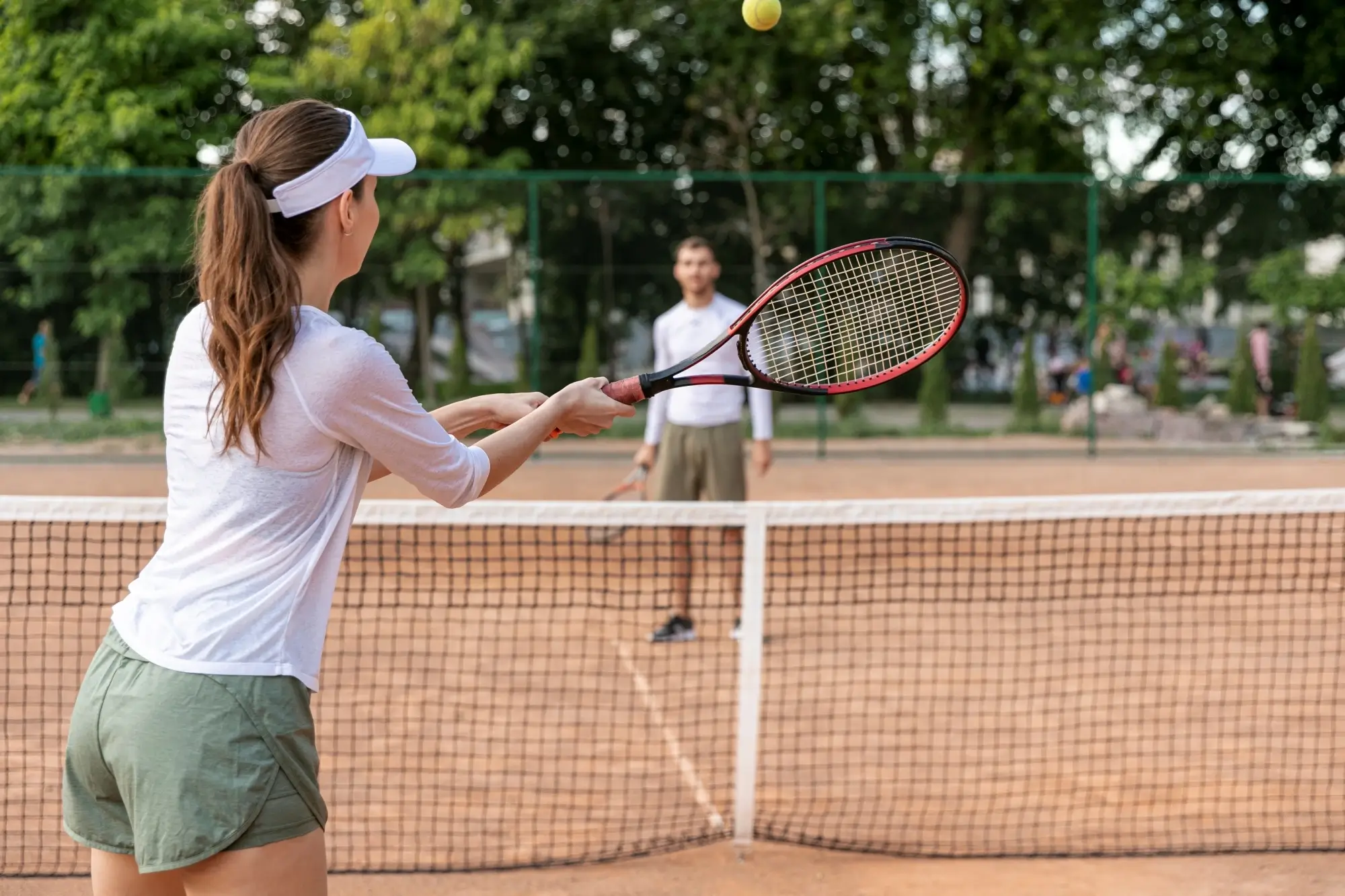
When you first start playing tennis, there’s usually one thing you want right away: to be able to rally properly. After just a couple of practice sessions, you may already be imagining a clean cross-court forehand, serves that consistently go in, and smooth volleys at the net. Then you actually pick up the racket.
Sometimes the ball hits the frame, your forehand goes too long, and your serve finds the net more often than the service box. Don’t worry, every player goes through that stage. Instead of rushing to learn shots that look impressive, training should start with the basics. That means getting comfortable with the racket, improving footwork, understanding timing, and gradually making your shots more consistent.
You don’t need to train for hours right away. What matters most is understanding the movements and practicing them regularly. If you’ve just started playing tennis, these drills can help build a solid foundation before moving on to longer rallies and more serious matches.
What Should Beginner Tennis Players Practice?

When you’re just starting out, it can feel like you need to learn everything at once. Forehand, backhand, serve, volley, footwork. And then there’s the scoring system to remember too. In reality, learning tennis usually feels much easier when you take it step by step.
For beginners, the main focus can start with controlling the racket and ball, moving into the right position, and getting more shots into the court consistently. Power can come later. Because a powerful forehand may look great, but if the ball keeps landing outside the lines, the point still goes to your opponent.
Tennis Training for Beginners You Can Try
Here are a few tennis training drills for beginners that you can practice with a coach, a partner, or during a regular training session.
1. Start with Shadow Swings
You can actually start practicing even without a ball. A shadow swing means repeating your stroke motion without hitting a ball. You can practice your forehand and backhand while paying attention to your foot position, body rotation, and swing path.
This type of drill helps your body get familiar with the movement before you have to think about an incoming ball. Keep the tempo relaxed. There’s no need to swing as hard as possible. Focus first on making the movement feel comfortable and controlled.
2. Get Comfortable Controlling the Ball with Your Racket
Before trying to build a long rally, spend some time getting familiar with the ball. One simple drill is bouncing the ball repeatedly on the face of your racket. It looks easy. Try doing it ten times without dropping the ball, and suddenly it feels a little more challenging.
This drill can help you develop a better feel for both the racket and the ball. You start to understand how much force is needed to keep the ball under control. It doesn’t need to turn into a fancy trick. The goal is simple, make your hand feel more comfortable with the racket.
3. Try Mini Tennis
Mini tennis can be one of the most useful drills for beginner players. Stand closer to the net and rally with your partner using shorter, controlled strokes. Because the distance is shorter, you don’t need to use much power.
Focus on control. Get the ball over the net. Keep it inside the court. Then repeat. Mini tennis also helps you work on timing and find a more comfortable contact point before gradually moving farther back toward the baseline.
If beginners start rallying from the baseline too early, they sometimes focus too much on hitting hard enough to get the ball across. But at this stage, control matters more.
4. Practice Forehands in One Direction
The forehand is usually one of the first strokes beginners learn. To make it more consistent, start with a simple target. Ask your coach or partner to feed balls repeatedly to your forehand side, then focus on returning them to one specific area. You don’t need to aim for the lines yet. Start with a bigger target.
For example, aim toward the middle of the court or a safe cross-court area. With a relatively consistent feed, you can focus more on your footwork, racket preparation, contact point, and follow-through. Once that feels more comfortable, you can start changing direction.
5. Don’t Forget Your Backhand
There’s usually a point when beginner players realize:
“Why am I trying to hit every ball with my forehand?”
If you constantly have to run around the ball just to avoid using your backhand, it’s probably time to get more comfortable with it. Practice your backhand separately, just like your forehand.
Start with relatively easy balls coming in a consistent direction. Focus on making comfortable contact and getting the ball back into the court. Your backhand doesn’t need to become a winner right away. Being able to return the ball consistently is already progress.
6. Practice Footwork Without the Ball
In tennis, having a good swing isn’t enough if your body is always late getting into position. That’s why footwork is an important part of training. You can practice split steps, side shuffles, moving left and right, and then recovering to your ready position. You can even do these drills without a ball. The goal is to train your feet to move before your hands start the stroke.
The quicker you can get into a comfortable position, the easier your shots will usually feel. Sometimes the problem isn’t your forehand. Your feet just haven’t arrived yet.
7. Learn the Serve Step by Step
The serve is often one of the most exciting—and frustrating—shots to learn. Don’t chase power right away. For beginners, start by developing a comfortable motion, a relatively consistent toss, and controlled contact with the ball. You can also practice from a shorter distance before moving back to hit a full serve from the baseline.
The first goal is simple: Get the ball into the service box. Once your serve becomes more consistent, you can start thinking about placement and variation. The ace can wait. Get the serve in first.
8. Practice Rallying with a Shot Target
Already feeling more comfortable with your forehand and backhand? Now make your rallies a little more challenging. Set a target with your partner. For example, try to hit five shots in a row without an error. Made it? Increase the target to ten. This type of drill shifts your focus from “I need to hit hard” to “I need to keep the ball in play.”
For beginner players, learning how to maintain a rally is really useful because it helps build both consistency and confidence. And there’s something satisfying about a rally that used to end after three shots suddenly going beyond ten.
9. Start Practicing with a Score
Once your rallies become more stable, start introducing match situations. You don’t have to play a full set right away. You can start with short games or practice tie-breaks based on your coach’s guidance or whatever format you agree on. The goal is to get used to making decisions when the score matters.
Because hitting the ball during a relaxed rally can feel very different from hitting it when you’re facing break point. This is where you start learning that tennis isn’t only about technique. It also involves focus, strategy, and the ability to reset after making an error.
How Often Should Beginners Practice Tennis?
There’s no single number that works for everyone. Your training frequency can depend on your schedule, physical condition, and personal goals. What matters more is consistency. Instead of having one very long practice session and then not touching a racket for several weeks, more regular sessions can help the movements start to feel more familiar. You also don’t need to work on every technique in every session.
One day, you might focus on forehand and footwork. The next session could be backhand and serve. Then leave some time for rallying. Little by little, those separate skills start connecting into a more complete game.
Training More Consistently? Try FiberCreme Tennis Cup 2026
If your training is becoming more consistent and you’re starting to feel curious about playing in a real match environment, there’s FiberCreme Tennis Cup 2026, taking place on September 19–20, 2026, at Ancol Tennis Warehouse (ATW), Jakarta.
FiberCreme Tennis Cup 2026 features a Women’s Doubles Team category for Upper Beginner, Low Intermediate, and Intermediate players, as well as a Women’s Doubles Individual category for Low Beginnerplayers. That means women at different playing levels can choose a category that matches their current ability.
FiberCreme Tennis Cup 2026 is also part of FiberCreme’s 9th anniversary celebration, carrying the spirit of PLAY. FUEL. FEEL GOOD., bringing together sports, community, and an active lifestyle in oneexperience.
Read more: Looking for a Tennis Tournament in Jakarta in September 2026? Get to Know FiberCreme Tennis Cup 2026
You Don’t Have to Be Great Right Away—Just Start
In the end, beginner tennis training doesn’t need to be complicated. Start with shadow swings, ball control, mini tennis, forehand, backhand, footwork, serves, and simple rallies. It’s okay if there are plenty of errors at first. Hit the frame? Keep going. Serve into the net? Try again. Rally ends after the third shot? Make four the next target.
Progress in tennis often comes from small things repeated over time. Once your training becomes more consistent, your game starts feeling more comfortable, and you’ve found the right doubles partner, you can start taking on a new challenge through competition. Sign up for FiberCreme Tennis Cup 2026!
For more information and registration:
Dorthy: 0877-8433-9701
Albert: 0816-1110-656
Don’t forget to follow @fibercreme, @ancoltenniswrhouse, and @infinitetournament on Instagram for the latest event updates. Start with one shot, build it into one rally, and enjoy the process.
Let’s PLAY, FUEL, and FEEL GOOD at FiberCreme Tennis Cup 2026!





0 Comments