
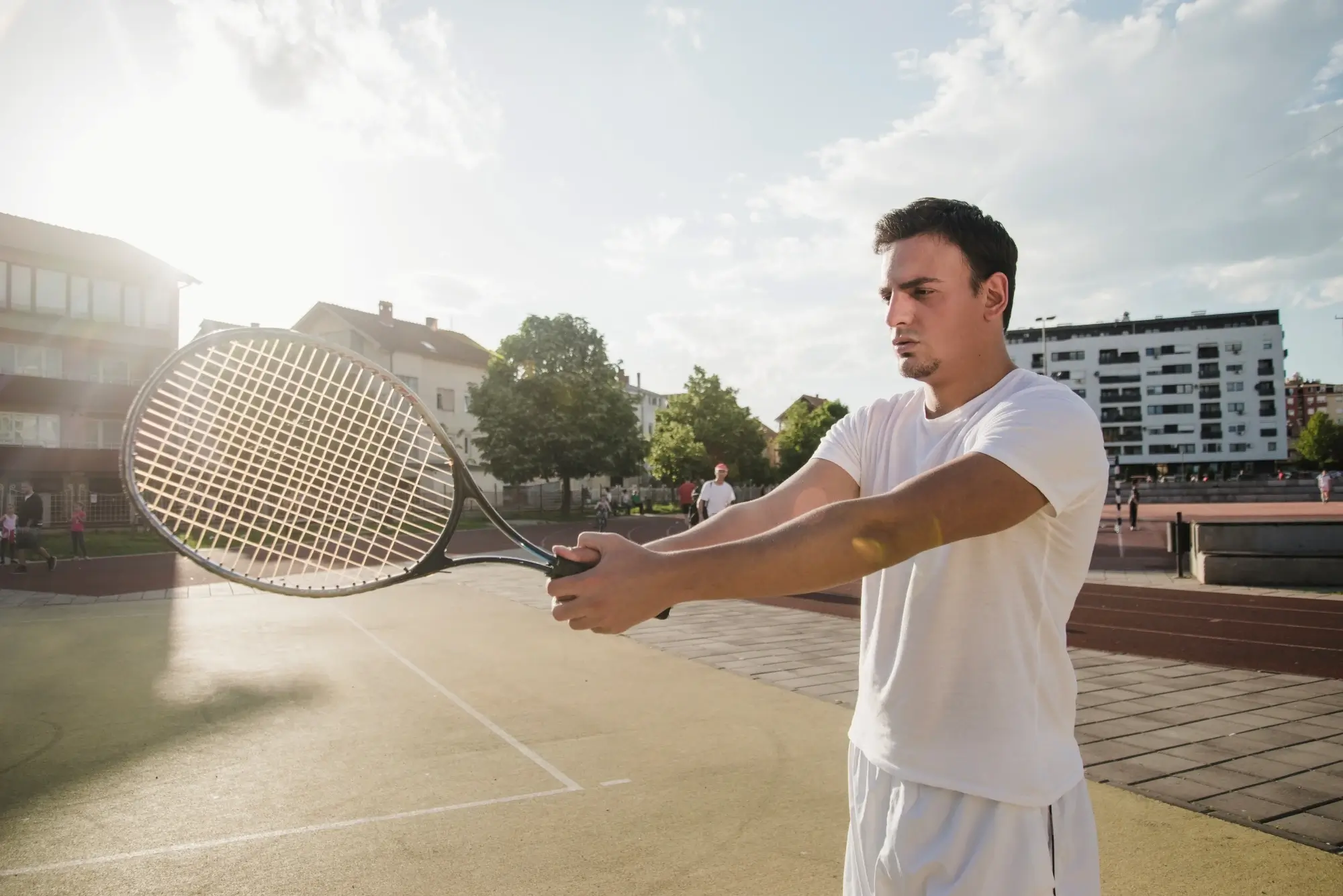
The first game is going well. The rallies are solid, your serve is going in, and everything feels like it’s going according to plan. Then one forehand goes out. The next point ends with a double fault. Before you’ve even had time to move on, your mind starts getting noisy:
“Why did I hit it there?”
“Don’t make another error.”
“What if I lose this game?”
Then the next ball comes, but mentally, you’re still stuck on the previous two points. Relate? In tennis, technical ability is definitely important. But once you’re in a real match situation, focus plays a big role too—especially when the score gets tight, your opponent changes strategy, or you’ve just madeseveral errors in a row.
That’s why stay focused while playing tennis can help you feel calmer and more in control until the very last point. It doesn’t mean you have to play without ever feeling nervous. What matters is knowing how to bring your attention back to the game whenever your mind starts wandering.
Why Is Focus Important in Tennis?

Tennis moves quickly. Once one point ends, it’s only a short time before you need to be ready for the next one. If you’re still thinking about your previous mistake, your preparation for the next point can suffer too. Your footwork becomes late. Your decisions feel rushed.
A ball that could have been played safely suddenly gets forced into a winner. And it can happen when you’re ahead too. Sometimes you start thinking:
“Just a little more and I’ve got this.”
Then your attention shifts from the ball you’re actually playing to the result of a match that isn’t even over yet. That’s why staying focused matters—not only when you’re behind, but also when you’re leading.
How to Stay Focused While Playing Tennis
Focus isn’t something only experienced players have. These small habits can be practiced even when you’re still a beginner. Here are several ways to stay focused while playing tennis that you can try on court.
1. Play One Point at a Time
The score is only 15–15, but your mind is already calculating:
“If I win this game, then break in the next one…”
Hold on. In tennis, thinking too far ahead can pull your attention away from the point you’re actually playing. Try focusing on one simple goal: Play this point first. Once that point is over, then think about the next one.
This becomes even more important when the score gets tight. Instead of calculating how many points you need to win the match, focus on what you can do right now. Serve to your target. Get ready with your split step. Watch the ball. Hit. Simple, but sometimes that’s exactly what you need.
2. Build a Small Routine Between Points
One way to focused while playing tennis is to create a simple routine after every point. For example:
Finish the point. Walk back into position. Control your breathing. Adjust your grip. Choose your serve or return target. Then get ready again. A routine like this gives your mind a kind of “bridge” between the previous point and the next one.
It doesn’t need to turn into a five-minute ritual. The important thing is consistency. Because if every error is followed by a long period of frustration, your mental energy can disappear pretty quickly too.
3. Don’t Carry an Error into the Next Point
That last forehand went way out. Annoying? Sure. But don’t carry it with you for the next three games. Every player makes errors. Even the shot you trust the most can miss sometimes.
What you need to practice is how you respond. Do a quick evaluation. Were you late? Did you rush? Did you fail to move forward enough? Once you understand what happened, move on.
The next point doesn’t need to pay for the mistake from the previous one. If you keep replaying it in your head, your opponent may already be ready to serve while you’re still arguing with your own forehand.
4. Focus on What You Can Control
Your opponent gets a net cord and the ball drops perfectly on your side. Frustrating? Definitely. But you can’t control it. The wind changes. The bounce feels strange. Your opponent suddenly starts playing much better.
All of those things can happen. Instead of spending your focus on things outside your control, shift your attention toward what you can manage. Footwork. Placement. Shot selection. Court positioning. Communication with your partner.
The clearer you are about what you want to do, the less space there is for your mind to get distracted by everything else.
5. Don’t Overthink the Score
The score is obviously important. But being too focused on it can change the way you play. When you’re down 0–40, you may start panicking and forcing shots. When you’re up 40–0, you might relax too much. But every point still needs to be played.
Try treating the score as information, not pressure. The score tells you where you are in the match. But it doesn’t have to determine the quality of your next shot. There’s still a ball to play. Focus on that first.
6. Use Your Breathing to Help You Reset
When a match starts getting tense, your body can tighten up without you realizing it. Your shoulders rise. Your grip gets tighter. Your movement doesn’t feel as smooth as usual. Between points, take a few seconds to control your breathing and relax your body.
It doesn’t need to be dramatic. Take a comfortable breath in, breathe out slowly, then get back into position. The goal isn’t to completely eliminate nerves. It’s simply to give yourself a little space to reset. Because playing while constantly tense can make every shot feel more forced.
7. Choose a Target Before You Serve or Return
Instead of standing at the baseline thinking:
“Just get it in.”
Try choosing a clearer target. Serve to the body. Serve to the backhand. Return cross-court. Get the first ball back safely. Simple targets help your mind focus on execution. Even beginners don’t need to aim for the lines right away. A bigger target area is perfectly fine. What matters is going into each point with some kind of plan. Even if that plan is as simple as:
“Just get the first ball in.”
8. If You’re Playing Doubles, Keep Communicating with Your Partner
In doubles, focus doesn’t come only from yourself. Your partner plays an important role too. If both of you go quiet and tense after an error, the atmosphere can change quickly. Try to keep communicating between points.
“Let’s go cross-court first.”
“I’ll cover the middle.”
“Stay at the net.”
Or simply:
“Next point.”
Simple communication can help both of you return to the strategy instead of continuing to think about the mistake. And if your partner makes the error, try not to make the situation heavier. One ball already went out. No need for your partner’s mood to go out with it too.
9. Practice Focus During Practice Matches
Focus needs training too. If every practice session is just relaxed rallying without a score, it’s going to feel different when you enter a real match. Every now and then, play a practice match with scoring. Play out deuce. Start a game at 30–30. Or simulate being behind.
Situations like these can help you understand how you react when there’s a little pressure.
Do you rush? Do you suddenly become afraid to hit the ball? Do you become too aggressive?
From there, you can start finding the reset routine that works best for you.
Feeling More Focused? Try the Tournament Atmosphere
Staying focused during practice is one thing. Doing it in a real match can feel completely different. There’s the score, unfamiliar opponents, the atmosphere of the venue, and nerves that may already start before you even step onto the court. If your training has become more consistent and you want to see how your game holds up in that kind of situation, there’s FiberCreme Tennis Cup 2026, taking place on September 19–20, 2026, at Ancol TennisWarehouse (ATW), Jakarta.
FiberCreme Tennis Cup 2026 features a Women’s Doubles Team category for Upper Beginner, Low Intermediate, and Intermediate players, as well as a Women’s Doubles Individual category for Low Beginnerplayers. That means women at different playing levels can choose a category that matches their current ability.
FiberCreme Tennis Cup 2026 is also part of FiberCreme’s 9th anniversary celebration, carrying the spirit of PLAY. FUEL. FEEL GOOD., bringing together sports, community, and an active lifestyle in oneexperience.
Read more: Looking for a Tennis Tournament in Jakarta in September 2026? Get to Know FiberCreme Tennis Cup 2026
Don’t Let One Error Take Over the Whole Match
In the end, staying focused isn’t about keeping your mind completely blank throughout the match. What matters is learning how to bring your attention back whenever your focus starts to slip. Play one point at a time. Build a routine between points. Reset after an error. Focus on what you can control. And if you’re playing doubles, keep communicating your plan with your partner.
Because one forehand that goes out only costs you one point. Don’t let one error take the next five points with it. If your training is becoming more consistent, your doubles partner is ready, and you want to test your focus in a real match atmosphere, sign up for FiberCreme Tennis Cup 2026!
For more information and registration:
Dorthy: 0877-8433-9701
Albert: 0816-1110-656
Don’t forget to follow @fibercreme, @ancoltenniswrhouse, and @infinitetournament on Instagram for the latest event updates. One point is over. Reset. Then play the next ball.
Let’s PLAY, FUEL, and FEEL GOOD at FiberCreme Tennis Cup 2026!





0 Comments